


● Introduction to Flanges
A pipe flange connects piping and components in a piping system by use of bolted connections and gaskets. Most commonly used flanges are weld neck flange, slip on flange, blind flange, socket weld flange, threaded flange and lap joint flange (RTJ Flange). This type of connection in a pipe flange allows for ease of disassembly and separation for repair and regular maintenance. Most common specification for carbon steel and stainless steel flange is ANSI B16.5 / ASME B16.5.
Metal flanges are commonly used for industrial, commercial, and institutional application. Steel pipe flanges are available in variety of styles and pressure classes. Metal flanges are classified from 150 to 2500 # rating. In addition to specifying pressure class, certain flanges such as weld neck flange & socket weld flange also require specifying the pipe schedule. This ensures the pipe bore will match the bore of the weld neck or socket weld flange.
SSM offers wide variety of pipe flanges in carbon steel, stainless steel and nickel alloy. We can also provide special flanges such as long weld neck flange, special material request and high-yield pipe flanges.
Classification of flanges is done in several alternate ways as follows;
● Based On Pipe Attachment
Flanges can be classified based on the method of attachment to the piping as below;
● Welding Neck Flange
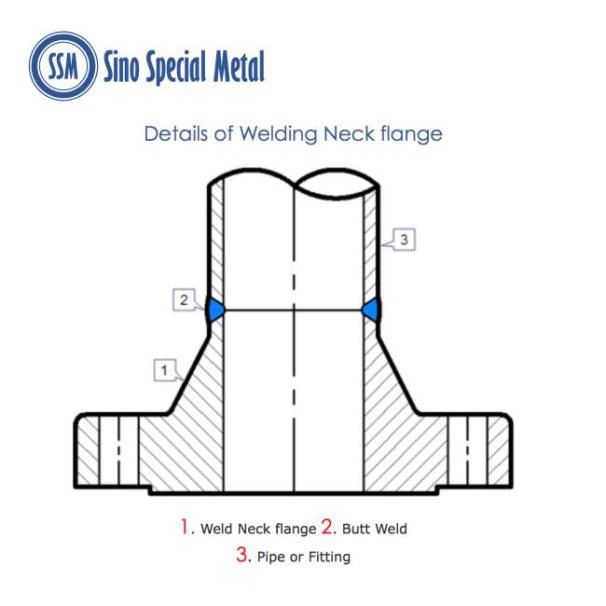
A welding neck flange (also called a 'weld neck flange') is well recognized for its long-tapered hub, which provides mechanical strength (useful to resist 'dishing' and 'bowing'). Welding neck flanges are high integrity flanges and are available in all sizes, all common face types (flat, raised, RTJ), and all classes. Due to the strength of the hub and the integrity of the weld, this type of flange is well suited for elevated temperature and pressure applications.
|
|
Welding Neck Flange Cross Section: 1. Weld Neck Flange; 2.Butt Weld; 3. Pipe or Fitting | |

● Slip-on Flanges
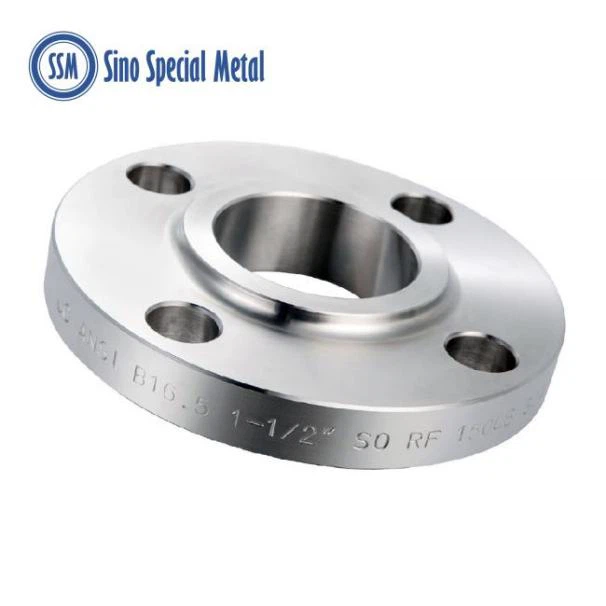
Slip-on flanges, also known as 'hubbed flanges', have a hub with a very low profile. This type of flange is usually connected to a pipe by one or two fillet welds (one outside the flange and one inside the flange), it is however possible to use only a single weld. Slip-on flanges are produced in many sizes and favoured for lower pressure applications (ASME class ≤ 600). A slip-on flange’s bore size (internal diameter) is larger than that of the connecting pipe, which allows it to slide/slip onto the pipe (slip-onto the pipe). There is no full penetration weld between the pipe and the flange, thus there are limitations for its usage due to lower weld integrity.
|
|
Slip-on Flange Cross Section: 1. Slip On Flange; 2. Filled weld outside; 3. Filled weld inside; 4. Pipe | |

● Socket Weld Flanges
Socket weld flanges have a socket in which a pipe is inserted; the pipe is secured by one fillet weld located on the exterior of the flange hub. A significant disadvantage with this type of flange is that it is not considered a high-integrity joint because the weld is difficult to prove; thus socket weld flanges are only suitable for low to medium classes (≤ ASME 600). Due to their lower integrity and unsuitability for use at higher pressures, socket weld flanges almost always have flat or raised faces. Socket weld flanges are designed for small nominal pipe sizes (≤ 4 inches, ≤ 10cm) and are common for ½ to 2-inch pipe sizes (1.3 to 5cm pipe sizes). The mechanical strength of a socket weld flange is similar to that of a slip-on flange, but the slip-on flange may use two welds.
|
|
Socket Weld Flange Cross Section: 1. Socket weld flange; 2. Filled weld; 3. Pipe; X=Expansion gap | |


● Threaded Flange
The threaded flange design (also called a 'screwed flange') uses a screw thread to connect the flange to a pipe. A male thread is cut onto a pipe end whilst a female thread is cut into the bore of the flange; the male threaded pipe is then screwed into the female threaded flange.
Even though the threaded flange design is available in many sizes and pressure ratings, it is mainly used for small sized piping systems i.e. ≤ 4 inches. Its usage is also typically restricted to non-toxic systems, low pressure systems, and low temperature systems. ½ inch to 2-inch size threaded flanges are much more common than sizes of 2 inches and above. Due to their lower pressure applications, threaded flanges use flat and raised faces only. They are not suitable for high temperature applications because the thread geometry would distort, which often leads to leakage.
|
|
Details of Threaded Flange: 1. Threaded flange; 2. Thread; 3. Pipe or Fitting | |


● Blind Flange
A blind flange (also called a 'closure plate flange') is installed at the end of a piping system to terminate a pipe. It has no centre hole (bore), so there is no flow through the flange. A blind flange may be used for isolating a pipe, valve, or pressure vessel. This type of flange is available in all sizes and classes, and may use a flat, raised, or ring-type joint face.
A blind flange can replace a butt weld cap in case an extension of the piping line is required, or in case a piping inspection is required (remove the blind flange to access the pipe interior). This type of flange can also be used as the rod access point on drain systems. Depending upon the application, a blind flange may be drilled and used as a slip-on flange, or tapped and used as a threaded flange.
|
|
Details of Blind Flange: 1. Blind flange; 2. Stud bolt; 3. Gasket; 4. Other flange | |


● Lap Joint Flange (LJF)
A lap joint flange (LJF) is an assembly of two elements involving a stub end and a lap joint ring flange (also called a 'lap joint flange'). To be technically correct, the stub end is not part of a lap joint flange. However, a lap joint flange is always used in conjunction with a stub end, so both parts are often collectively referred to as a 'lap joint flange'. Due to their design, lap joint flanges always have a flat face with a smooth surface. But, when combined with the stub end, the resulting sealing face is raised. This occurs because the sealing face of the stub end is above the flange’s bolting plane. The lap joint flange has no sealing face, only the stub end has the sealing face. The sealing face of a stub end may be plain, serrated, or grooved to allow for a ring type joint.
|
|
Details of socket lap joint flange: 1. Lap joint flange; 2. Stub end; 3. Butt weld; 4. Pipe or fitting; 5. Radius | |


To assemble a lap joint ring flange and stub end, the stub end must slide into the bore of the flange ring and then be butt welded to the pipe. One side of the stub end forms the sealing face, whilst the opposite/back side of the stub end presses against the lap joint flange ring (when the flange is assembled). The lap joint flange ring is free to rotate after the stub end is welded to the pipe, this is because it is not physically joined to the stub end. Once the flange joint has been assembled, the lap joint ring is no longer free to rotate.
Other flange types many engineers will encounter are the male and female, and tongue and groove types. Less common types include the orifice, expander, reducing, and long welding neck flange designs.
Flange ends may be screwed, welded, or lapped (metal to metal contact) to their associated piping.
Flange Types Overview
Some important information concerning flange types has been compiled into the below table. Although ASME standards are cited in the table, alternative international and national standards are available (DIN, EN etc.). ASME is however the most widely accepted piping standards organization, and for this reason its standards have been cited.
In the below table, the 'Faces' column indicates the usual sealing face chosen per flange type. However, there may be exceptions to the rule depending upon the flange type. The table should be treated as a general overview table, whilst specific information should be sought in relevant standards.
Flange Type | NPS (inch) | ASME Class | Faces | Joint Integrity | Weld | ASME Standards |
Welding Neck Flange | All | All | All | High | One butt weld. | B16.5, B31.3 |
Slip-on Flange | Many | Generally, ≤ 600 | FF, RF | Medium | One or two fillet welds. | B16.5, B31.3 |
Socket Weld Flange | Generally, Max ≤ 4 | ≤ 600 | FF, RF | Medium | One fillet weld. | B16.5, B31.3 |
Lap Joint Ring Flange | Not used for small sizes. | NA | FF | NA | None | B16.5, B31.3 |
Stub End of Lap Joint Flange | 150 to 2500 | FF, RF, RTJ | High | One butt weld. | B16.9, B31.3 | |
Threaded Flange | Generally, Max ≤ 4 | ≤ 300 | FF, RF | Low | None | B1.20.1, B31.3 |
Blind Flange | All | All | All | NA | None | B16.5, B31.3 |
Table Key: FF– flat face. RF–raised face. RTJ–ring type joint. | ||||||
● Based On Facing
There are three common types of flange face, the plain/flat, raised, and ring-type joint (RTJ). Other types of flange face exist, primarily the Tongue-and-Groove (T&G), Lap Joint, and Male-and-Female (M&F) designs, but these are less popular. Piping standards define the exact geometry, dimensions, material, and surface finish of a flange face.
The flanges can also be classified based on the facings as below:
● Raised Face Flange (RF)
A raised face (RF) flange has circular shaped sealing face that protrudes from the flange’s bolting circle plane. Raised face flanges are available in all pressure classes, and thus for a wide range of pressure and temperature ratings. RF flanges are the most common type of flange employed in the Oil and Gas and chemical engineering industries.
RF flanges use serrated sealing surfaces with non-metallic or semi-metallic type gaskets. The sealing face of an RF flange is from the flange’s inner diameter to the outside diameter of the raised face. A typical gasket for RF flanges would be a graphite steel composition gasket with a temperature rating up to 400⁰C (750⁰F) and a pressure rating of up to 250 bar (3,625 psi).
The height of the raised face above the bolting face plane is dictated by the flange’s class and the standard from which it is taken. For the ASME B16.5 standard, steel flanges in classes 150 and 300 have a raised face height of 1/16 inch (1.6mm); steel flanges exceeding class 300 use a 1/4 inch (6.4mm) raised face. In an ideal world, the height of a raised face would increase as the class increases, but this does not occur in most standards; it is however a logical generalization.
|
Flat Face Flange (left) and Raised Face Flange (right) |

● Flat Face Flange (FF)
Flat face (FF) flanges use non-metallic gaskets (soft gaskets) and should always have a serrated sealing surface. This type of flange is well suited to low pressure applications and is used for pressure classes 125 and 250.
Gaskets are installed directly on the front sealing face of the flange blade i.e. on the same plane as the bolting circle face. The gasket sealing area is from the inner flange diameter to the outer flange diameter. Typical soft gasket materials are usually rated to 100⁰C (212⁰F) and not more than 20 bar (290 psi) pressure. Because flat face flanges use such a large sealing area, they are made to fit. Flat face flange gaskets cannot rotate once installed due to the bolt hole penetrations through the gasket. Due to the large size of the sealing face, flat face flanges are resistant to mechanical distorting (bending, bowing etc.).
Flat face flanges should never be mated with raised face flanges, particularly if the raised face flange is manufactured from a harder material.
|
Full (left) and Raised Face (right) Flanges and Gaskets |

● Ring Type Joint (RTJ)
Ring-type joint (RTJ) flanges are a variation of the raised face flange design. RTJ flanges are typically used for more severe applications, particularly for high pressure systems, and/or high temperature systems (>750⁰C / 1,382⁰F). It is possible to use RTJ flanges across all pressure classes, but they are typically used for class 900 and above.
The difference between an RTJ flange and a raised face flange is the way a seal is obtained. Metal gaskets (hard) are used with RTJ flanges, whilst raised face gaskets use soft or semi-metallic gaskets. There are three main ring type joint groups, these are R, RX and BX; we will focus on the R type joint because it is by far the most common.
R-type RTJ gaskets are circular in shape with an oval or octagonal shaped profile/body; the octagonal profile obtains the most efficient seal and is the more modern design. A groove is machined into the face of an RTJ flange and the associated gasket is installed into this groove. When the flange is assembled, the two mating faces compress the gasket until it deforms and a metal to metal seal is formed. If the flange is assembled correctly, the two mating RTJ flanges should not come into physical contact with each other.
|
RTJ Components (Octagonal Gasket left, Oval Gasket right) 1. Steel Stud; 2. Steel Washer; 3. Insulating Washer; 4. Insulating Sleeve; 5. Gasket; 6. Steel Nut |

RTJ gaskets are often manufactured from a material slightly softer than that of the flange. Because the gasket material is softer, it deforms at a lower pressure than the flange, this ensures that it is the gasket that deforms to make the seal rather than the flange deforming around the gasket.
● Tongue and Groove (T/G)
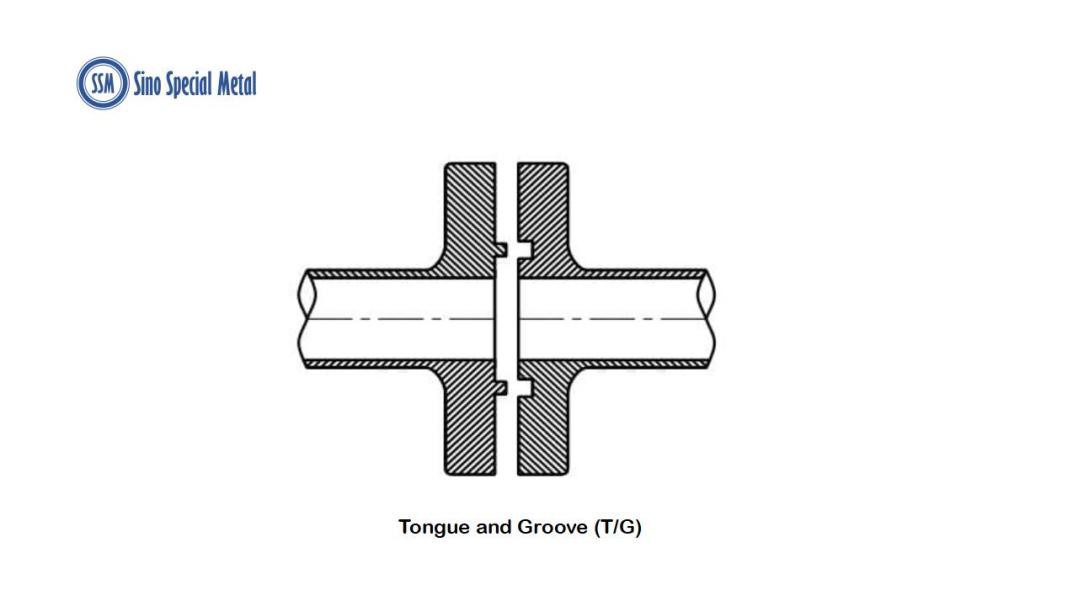
One flange face has a raised ring (Tongue) machined onto the flange face while the mating flange has a matching depression (Groove) machined into it’s face. The Tongue and Groove faces of this flanges must be matched. Tongue-and-groove facings are standardized in both large and small types. They differ from male-and-female in that the inside diameters of the tongue-and-groove do not extend into the flange base, thus retaining the gasket on its inner and outer diameter. These are commonly found on pump covers and Valve Bonnets. Tongue-and-groove joints also have an advantage in that they are self-aligning and act as a reservoir for the adhesive. The scarf joint keeps the axis of loading in line with the joint and does not require a major machining operation.
|
Tongue and Groove (T/G) |
● Male and Female (M/F)
With this type the flanges also must be matched. One flange face has an area that extends beyond the normal flange face (Male). The other flange or mating flange has a matching depression (Female) machined into it’s face. The female face is 3/16-inch deep, the male face is 1/4-inch high, and both are smooth finished. The outer diameter of the female face acts to locate and retain the gasket. Custom male and female facings are commonly found on the Heat Exchanger shell to channel and cover flanges. The female face and the male face are smooth finished. The outer diameter of the female face acts to locate and retain the gasket.
|
1. Large Male & Female Flanges; 2. Small Male & Female Flanges |

Flange Face Summary
The below table summarizes characteristics of the three most common flange faces.
Flange Face Type | |||
Characteristics | Flat Face | Raised Face | Ring-Type Joint |
Sealing Area | Large | Medium | Small |
Sealing Face | Inner diameter to outer diameter. | Inner diameter to raised face outer diameter. | Groove in flange face. |
Pressure Range | Narrow. Low pressures only. | Broad | Broad. Generally used for higher pressures. |
Pressure Class | 125#, 250# | All. | All. Generally ≥ 900#. |
Temperature Range | Narrow. Low temperatures only. | Broad | Broad |
Gasket Type | Soft. Non-metallic. | Non-metallic, semi-metallic. | Hard. Metal. |
● Based On Face Finish
The flange face surface is the area where the sealing element (gasket) is installed. The most common flange face surface designs are smooth and serrated. Flat face (FF) flange surfaces and raised face (RF) flange surfaces require serrations if built to industry standards.
● Stock Finish
The most widely used of any flange surface finish, because practically, is suitable for all ordinary service conditions. Under compression, the soft face from a gasket will embed into this finish, which helps create a seal, and a high level of friction is generated between the mating surfaces. The finish for these flanges is generated by a 1.6 mm radius round-nosed tool at a feed rate of 0.8 mm per revolution up to 12 inch. For sizes 14 inch and larger, the finish is made with 3.2 mm round-nosed tool at a feed of 1.2 mm per revolution.
● Smooth Finish
This finish shows no visually apparent tool markings. These finishes are typically utilized for gaskets with metal facings such as double jacketed, flat steel and corrugated metal. The smooth surfaces mate to create a seal and depend on the flatness of the opposing faces to effect a seal. This is typically achieved by having the gasket contact surface formed by a continuous (sometimes called phonographic) spiral groove generated by a 0.8 mm radius round-nosed tool at a feed rate of 0.3 mm per revolution with a depth of 0.05 mm. This will result in a roughness between Ra 3.2 and 6.3 micrometers (125 – 250 micro inch).
● Serrated Finish
|
Concentric (left) and Spiral (right) Serrations |

This is also a continuous or phonographic spiral groove, but it differs from the stock finish in that the groove typically is generated using a 90-deg tool which creates a "V" geometry with 45° angled serration. The serrations provided on the facing could be concentric or spiral (phonographic). Concentric serrations are insisted for face finish when the fluid being carried has very low density and can find leakage path through the cavity. The serration is specified by the number, which is the Arithmetic Average Roughness Height (AARH). This is the arithmetic average of the absolute values of measured profile height deviations taken within the sampling length and measured from the graphical centre line.
|
1. Spiral serrated or phonographic; 2. Smooth Finish; 3. Stock Finish DN≤12"; 4. Stock Finish DN≥14" |

The smooth finish flanges are specified when metallic gaskets are specified and serrated finish is provided when a non-metallic gasket is provided.
Suitable Roughness Values
Industry standards dictate suitable roughness values, the following is taken from the ASME B16.5 standard:
Surface Types | Maximum Roughness Value |
Ring-type joint flanges (and hard gaskets) | 63 µin AARH (1.6 µm AARH) |
Spiral wound gaskets. | 125 to 250 µin AARH (3.2 to 6.3 µm AARH) |
Soft gaskets. | 250 to 500 µin AARH (6.3 to 12.6 µm AARH) |
Tongue and Groove, and small Male and Female | 125 µ.in. or 3.2 µ.m AARH |
● Based On Material Of Construction
The flanges are normally forged except in very few cases where they are fabricated from plates. When plates are used for fabrication, they should be of weldable quality. ASME B16.5 allows only reducing flanges and blind flanges to be fabricated from plate. The materials of construction normally used are as follows;
Standard | Specification |
ASTM A105 | Standard Specification for Carbon Steel Forgings for Piping Applications |
ASTM A181 | Standard Specification for Carbon Steel Forgings, for General-Purpose Piping |
ASTM A182 | Standard Specification for Forged or Rolled Alloy and Stainless Steel Pipe Flanges, Forged Fittings, and Valves and Parts for High-Temperature Service |
ASTM A350 | Standard Specification for Forged or Rolled Alloy and Stainless Steel Pipe Flanges, Forged Fittings, and Valves and Parts for High-Temperature Service |
ASTM A694 | Standard Specification for Carbon and Alloy Steel Forgings for Pipe Flanges, Fittings, Valves, and Parts for High-Pressure Transmission Service |
ASTM B151 | Standard Specification for Copper-Nickel-Zinc Alloy (Nickel Silver) and Copper-Nickel Rod and Bar |
ASTM B381 | Standard Specification for Titanium and Titanium Alloy Forgings |
ASTM B462 | Standard Specification for Forged or Rolled Nickel Alloy Pipe Flanges, Forged Fittings, and Valves and Parts for Corrosive High-Temperature Service |
ASTM B564 | Standard Specification for Nickel Alloy Forgings |
● Based On Pressure-Temperature Rating
The flanges are also classified by the pressure temperature rating in ASME B 16.5 as below;
150#
300#
400#
600#
900#
1500#
2500#
Pressure temperature rating charts, in the standard ASME B 16.5, specify the nonshock working gauge pressure to which the flange can be subjected to at a particular temperature. Flanges can withstand different pressures at different temperatures. As temperature increases, the pressure rating of the flange decreases. The indicated pressure class of 150#, 300#, etc. are the basic ratings and the flanges can withstand higher pressures at lower temperatures. ASME B 16.5 indicates the allowable pressures for various materials of construction vis-a-vis the temperature. ASME B16.5 does not recommend the use of 150# flanges above 400 °F (200 °C). The Pressure Class or Rating for flanges will be given in pounds. Different names are used to indicate a Pressure Class. For example: 150 Lb or 150 Lbs or 150# or Class 150, all are means the same.
● CONCLUSION
You can make out from the above different types of flanges, manufacturing, and performance features. You can choose the right steel flange manufactured from different materials like stainless steel, low alloy steel, carbon steel, duplex steel, or many more.
Choosing the right flange with the right material and knowing the elements that it faces during the application that uses the piping method is critical. We hope that this blog will help you identify the key things before purchasing flanges.


