




Fasteners
Sino Special Metal Co., Ltd: You Professional Fasteners Manufacturer!
SSM is your reliable fastener manufacturing partner. We provide a wide range of fastener solutions, including bolts, nuts, washers, semi-threaded bolts, hexagonal bolts, etc.
Why choose us?
Wide range of applications
Our wide range of products is used in a variety of industries including renewable energy, wind power plants, oil and gas industry, onshore, offshore and refineries more.
Quality Assurance
Our products are manufactured using the finest materials and undergo rigorous quality control measures to ensure they meet the highest quality standards.
Wide Range of Material Options
We specialize in the production of a diverse array of products using premium material grades such as Hastelloy, Inconel, Incoloy, Monel, Duplex, Stainless Steel, Alloy Steel, Carbon Steel, Titanium and many more.
Professional Technical Team
Our company has a team of highly skilled and dedicated professionals committed to providing fast and reliable service at an affordable price.


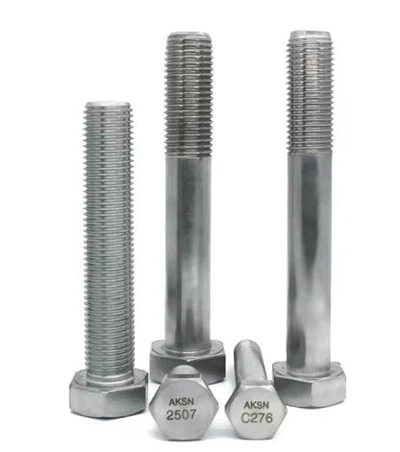

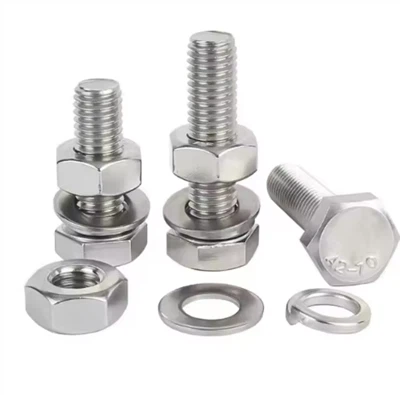


Types of Fasteners
Nails
Let’s start with the simplest fastener type: the nail. Although they come in several varieties, from roofing nails to ring shank nails, or straightforward carpentry nails, these fasteners are all characterized by the fact that they are straight, usually unthreaded, have flat heads, and are inserted by hammering.
01
Nuts and bolts
Bolts are probably the most common type of fastener. They are used to hold unthreaded components together and work in tandem with nuts. They have external male threads on one end and a hexagonal head and are tightened using a wrench. Because nuts are used with unthreaded components and, unlike screws, don’t provide holding power by way of their thread, they need to be installed with the aid of a nut. Nuts are ringlike fasteners that are attached to the ends of bolts. The different types of bolts include hex-head bolts, eye bolts, carriage bolts and u-bolts.
02
Screws
Screws are similar to bolts. They also have a male thread that starts right at the tip and usually covers the entire length of the screw. The heads of screws can come in many shapes and sizes, and there is an astonishing array of screws for all kinds of projects and materials. Unlike bolts, screws rely on their threads to maintain their hold. Most screws are self-tapping, meaning that they cut a thread into the material as they are screwed in. Among the many different types of stainless steel screws available are wood screws, deck screws, hex lag screws, self-drilling screws, and machine screws.
03
Rivets
Rivets are permanent fasteners that can be used to fasten all kinds of materials. They are incredibly lightweight and have a low profile against the surface of the material being fastened. Holes do not need to be threaded when rivets are used, but a special gun – a pop riveter – has to be used for application. Once a rivet is in place, it forms a permanent bond and cannot be removed. Rivets are preferred fasteners for the aerospace industry.
04
Washers
Washers are rings that are used in conjunction with nuts and bolts, being placed under the heads of nuts, joints or axle bearings. They are used for several different purposes, such as to alleviate friction, to allow more even distribution of pressure from the nut on the fastened component, to eliminate leakage, isolate components or prevent loosening due to vibration.
05
Ingredients of Fasteners
|
Element |
Composition Range |
|
Chromium (Cr) |
21.0 - 23.0% |
|
Nickel (Ni) |
4.5 - 6.5% |
|
Molybdenum (Mo) |
2.5 - 3.5% |
|
Nitrogen (N) |
0.10 - 0.22% |
|
Manganese (Mn) |
≤ 2.00% |
|
Silicon (Si) |
≤ 1.00% |
|
Phosphorus (P) |
≤ 0.030% |
|
Sulfur (S) |
≤ 0.015% |
|
Carbon (C) |
≤ 0.030% |
Surface Treatment of Fasteners
Electroplating surface treatment process for fasteners
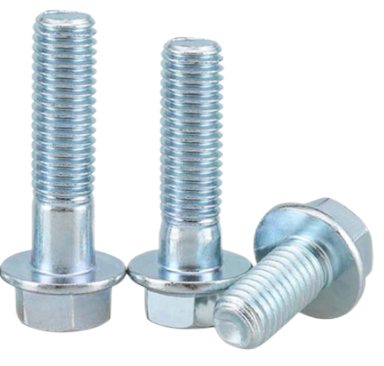
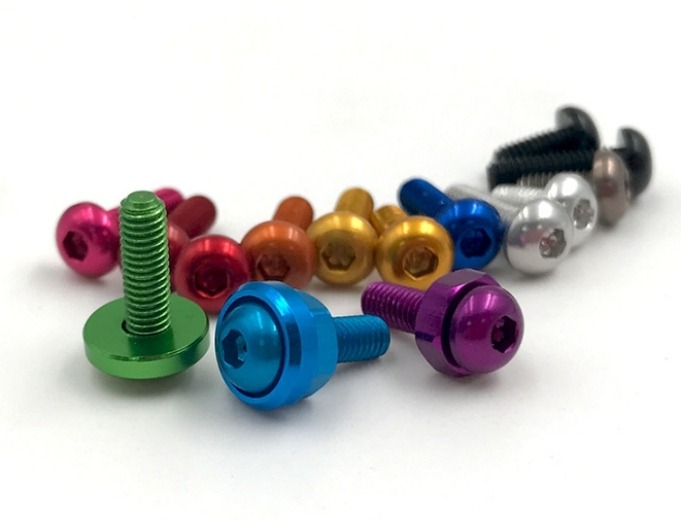
Electroplating surface treatment is a process that includes electrochemically depositing a thin layer of metal coating on the surface of the fastener. Zinc, nickel, and chromium are the most commonly used metals for electroplating. Zinc electroplating is extensively used for fasteners because it is both corrosion resistant and cost-effective.
Hot-dip galvanizing surface treatment process for fasteners
Hot-dip galvanizing is a surface treatment process that includes immersing the fastener in a molten zinc bath to coat it with a thick layer of zinc. This process is popular for fasteners used in outdoor settings because it provides excellent corrosion resistance and can last for many years.
Black oxide coating surface treatment process for fasteners
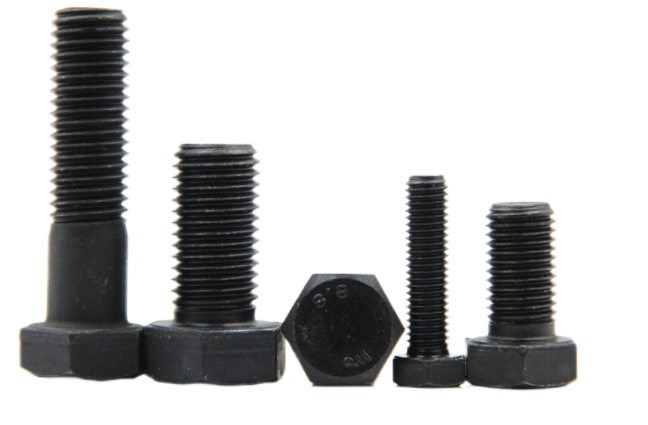
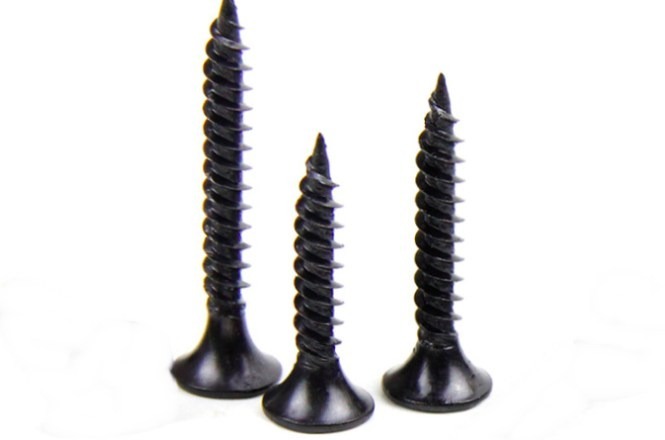
The black oxide coating is a surface treatment process that involves chemically treating the surface of screws to create a black oxide layer that increases corrosion resistance and lubricity. This method is frequently used for tiny fasteners like screws and bolts.
Phosphate coating surface treatment process for fasteners
Phosphate surface treatment includes treating the surface of screws with a phosphate solution to produce a thin, porous layer of phosphate crystals that improve corrosion resistance and lubricant retention. This method is frequently used for fasteners that require a lot of lubrication.
Powder coating surface treatment process for fasteners
Powder coating surface treatment process includes electrostatically adhering a dry powder coating to the surface of a fastener. The powder is then cured with heat, causing it to melt and create a long-lasting, smooth coating. Powder coating is a popular fastener surface treatment process due to its exceptional durability, corrosion resistance, and minimal environmental impact.
Inspection and Testing of Fasteners
Tensile testing:
Tensile testing is used to measure the tensile strength of a fastener. Tensile strength is the maximum amount of tensile stress that a fastener can withstand before it breaks.
01
Yield testing:
Yield testing is used to measure the yield strength of a fastener. Yield strength is the stress at which a fastener begins to deform plastically.
02
Fatigue testing:
Fatigue testing is used to measure the fatigue strength of a fastener. Fatigue strength is the maximum amount of cyclic stress that a fastener can withstand before it fails.
03
Torque testing:
Torque testing is used to measure the torque required to tighten a fastener to a specific preload. Preload is the amount of force that is applied to a fastener when it is tightened.
04
Corrosion testing:
Corrosion testing is used to measure the resistance of a fastener to corrosion. Corrosion can cause fasteners to fail prematurely, so it is important to ensure that fasteners are resistant to corrosion in the environment in which they will be used.
05
Application of Fasteners
Aerospace industry:
Airplanes and helicopters are an intricate mix of machines brought together to make us fly. Most of these machines, if not all, are held together with the help of fasteners. Excellent structural integrity is necessary for them, which is why the fasteners often used are of the highest quality possible.
Automobile industry:
Similar to the aerospace industry, the automobile industry also uses fasteners to create complex blocks of machines like the engine block, power train, wheels, doors. Additionally, the automobile industry uses them to fix things like the seat frame onto the chassis.
Petrochemical industry:
The primary job of the petrochemical industry is to drill and test for the natural resources it is looking for. For drilling and extracting such resources, many moving parts work in conjunction, which are once again held together by the fasteners.
Shipping industry:
Ships often use multiple types of fasteners like hex bolts, hex nuts, and socket head cap screws to create the frames. A ship uses almost every size of fastener available to build the same.