


Flanges are categorized based upon certain criteria, and these categories are usually defined by relevant piping standards and specifications. A flange is defined by Type, Face, Standards and Specification, Dimensions, Nominal Pipe Size (NPS), Pressure Class, Material, Schedule (SCH).

Identifying a flange is one of the challenges anyone dealing with hydraulic systems faces. The importance of these parts is often overlooked. However, their reliability is vital to the system’s integrity.
In order to find the right flange for your system, you need to identify it. The process is much more complicated than wielding a measuring tape. You need to consider the following factors during the identification process:
1) Identify The Flange Type
Flange types: refers to the flange design. Flange types are selected based on the temperature and pressure requirements, and are identifiable by their geometry.

Figuring out the type is the easiest step. All you have to do is look at it. The most common flange types are:
• Welding neck flange : has a tapered hub, used mostly in high-pressure systems
• Slip on flange : can be slipped over the pipe, welded inside and outside to increase durability, and avoid leaks
• Socket weld flange: connects to the pipe with one fillet weld on the outside of the flange
• Lap joint flange: used with lap joint stub end, can be slipped over the pipe but not welded, held in place by the pressure
• Threaded flange: attaches to a pipe without welding, used for pipes with thick walls to create an internal thread
• Blind flange: used to blank off the ends of valve and pipes, suitable for high-pressure environments

Flange Face: refers to the area used for sealing of the flange; a gasket is usually installed between the two opposing flange faces. Examples of flange faces include the flat, raised, ring-type joint (RTJ), lap joint, tongue and groove, and male and female designs.

Flange surfaces: refers to the condition of the flange face sealing surface. A flange face surface may be smooth, or serrated1. The smoothness of a flange face surface is defined by its Roughness Average (Ra) or Arithmetic Average Roughness Height (AARH).
2) Determine The Size
Dimensions: the dimensions of a flange’s hub, face, blade etc. Dimensions depend upon nominal pipe size (NPS) and the pressure class required for a given application.
Nominal Pipe Size (NPS) : a dimensionless unit of measurement defining the size of the item (pipe, fitting etc.) that connects to the flange.

Measuring the size of the flange is not an easy task. You need to find the outer diameter, the inner diameter, the number of bolt holes, bolt hole diameter, and the bolt circle diameter.
Bolt circle diameter (B.C.) is one of the most important measurements to make when identifying a flange. It’s the measure from the centre of the bolt hole to the centre of another bolt hole located on the opposite side of the flange.
3) Consider The Thickness
Schedule (SCH) – a pipe’s thickness/schedule. The schedule of a pipe is relevant only for welding neck and lap-joint flanges because the schedule of these flanges must match the associated pipe schedule to which they are connected. The other flange types either slide partly into, screw into, or penetrate through, their associated flange, thus the flange schedule does not need to match the pipe schedule. The schedule is relevant for swivel-ring flanges, but these have limited application and will not be discussed further.
A highly important flange parameter is its thickness. It determines the amount of pressure the flange can withstand. The thicker the flange, the higher the pressure it can work with. When measuring the thickness of the flange, you only need to measure the outer rim of the part.
4) Read About The Standards
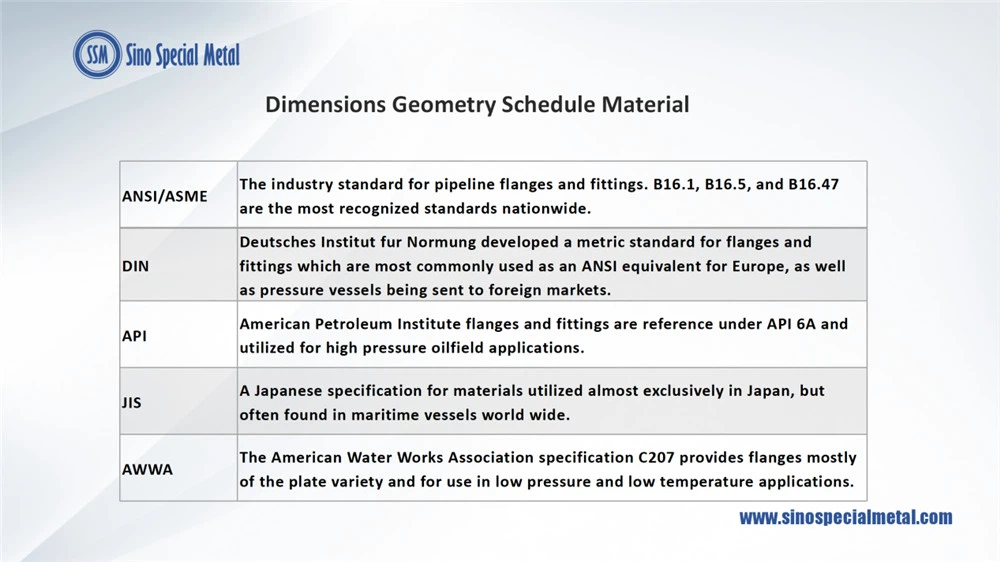
Standards and Specification: flanges are manufactured to comply with given standards and specifications. Standards and specifications dictate the dimensions, geometry, schedule, and material, of a given flange (to name a few factors).

Many standards exist for selecting the right flange for your needs. Depending on the application you are considering and the other components the flange will interact with, you can choose among ASME, ASTM, ANSI, API, MSS, AWWA, DIN, JIS, and more.
5) Handle The Pressure Class
Pressure Class – the pressure-temperature rating of the flange for a given material. Despite the name 'pressure class', this factor is material and temperature dependent.
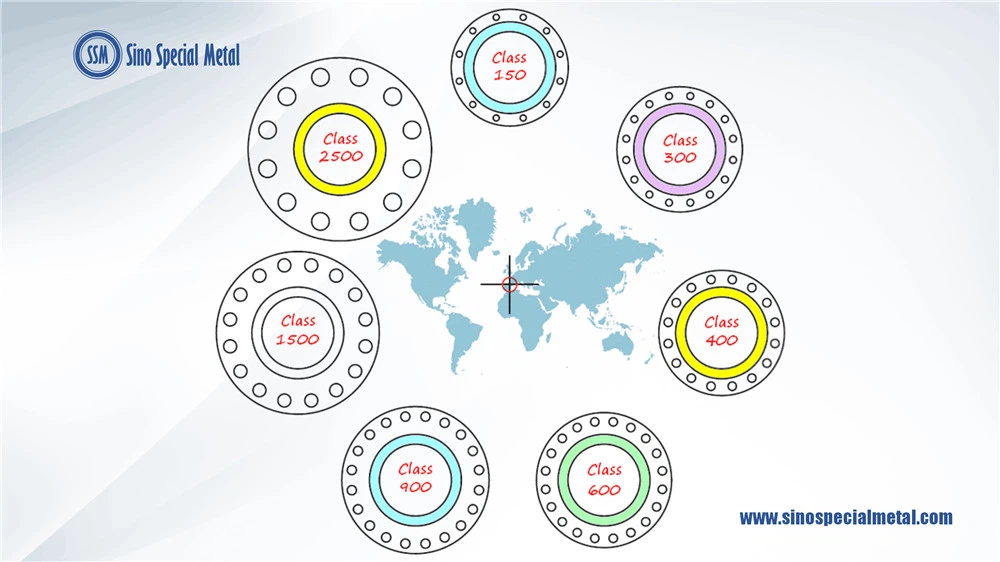
The pressure class of the flange determines the pressure it can support or operate under without breaking. Each of the above-mentioned standards offers several pressure classes, from low to high. Flange pressure class must be compatible with the pressure class of the parts it works with inside the system.
6) Choose The Materials
Material – the material from which the flange is manufactured e.g. cast iron, carbon steel, stainless steel etc.
Depending on the environment the flange will work in, it’s important to choose the materials it’s made of. Flanges may need to withstand pressure, humidity, high temperatures, corrosion, and more. They are commonly made of stainless or carbon steel as well as copper nickel.


