




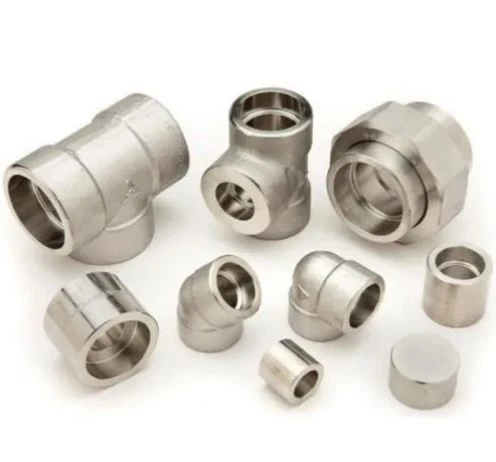
Forged Pipe Fittings
We are capable of producing products inf a wide range of material grades, such as Hastelloy, Inconel, Incoloy, Monel, Duplex stainless steel, Stainless steel, Alloy steel, Carbon steel, Titanium, and many more. This diverse range of materials allows us to cater to the specific needs of various industries. With this extensive product range, SSM is equipped to provide integrated piping solutions that meet the unique requirements of our customers.
At SSM, we are committed to meeting all of our clients' integrated piping solutions development needs, including customized jobs, by delivering high-quality products and services.

Why Choose Us
01
Quality Products
We use only the highest-grade materials and advanced manufacturing techniques to produce products that are reliable, durable, and perform to the highest standards.
02
Experienced Team
Our team of engineers and technicians has years of experience in the industry, and we leverage that expertise to provide our clients with the best possible solutions.
03
Exceptional Customer Service
We pride ourselves on providing exceptional customer service and technical support to our clients, ensuring that they have a smooth and hassle-free experience.
04
Continuous Innovation
We are constantly investing in research and development to stay ahead of the curve and deliver cutting-edge solutions to our clients.


What is Forged Pipe Fittings?
Forged Pipe Fittings is a category of Industrial pipe fittings which is used for high pressure piping. The category emphasis on the word "Forged" which indicates manufacturing process of this type of fittings.
Forged pipe fittings are components used to connect pipes and create a secure and leak-proof joint. These fittings are manufactured by subjecting the metal to extreme heat and pressure, resulting in a dense and strong structure. The forging process enhances the mechanical properties of the fittings, making them highly durable and resistant to wear and tear.A forged pipe fitting has a high quality as it has higher strength to withstand higher pressure. The wall thickness is thicker than other type of fittings for threading process or machining to socket weld end.
Benefits Of Fast Wireless Charging Pad
Durability and Longevity
At the heart of forge pipe fittings lies a commitment to durability that surpasses conventional alternatives. The forging process involves subjecting metals to extreme conditions, aligning their molecular structure for optimal strength. This imparts a remarkable level of resilience to forge pipe fittings, enabling them to withstand the rigors of continuous operation without succumbing to wear.
Precision Engineering for Seamless Integration
One of the standout features of forge pipe fittings, particularly in the realm of PVDF pipe fittings manufacturing, is the precision in engineering. The meticulous crafting of these components ensures seamless integration into a pipeline system, eliminating the risk of leaks or inefficiencies. This precision is paramount in industries where the slightest deviation can have cascading consequences.
Enhanced Corrosion Resistance
Corrosion poses a perennial threat to the integrity of pipelines, especially when conveying corrosive substances. Forge pipe fittings, crafted through processes such as PVDF pipe fittings manufacturing, emerge as stalwart guardians against corrosion. The inherent resistance of PVDF (Polyvinylidene Fluoride) to chemical degradation elevates these fittings to a league of their own, ensuring longevity even in the face of corrosive challenges.
Optimized Flow Characteristics
Fluid dynamics, a complex dance within pipelines, demands components that harmonize with the laws of physics. Forge pipe fittings, with their precisely engineered shapes and dimensions, optimize the flow characteristics of fluids. This results in reduced turbulence and pressure drops, contributing to enhanced efficiency in the transportation of liquids and gases.
Temperature Tolerance Beyond Ordinary
Industries grappling with extreme temperatures find solace in the exceptional temperature tolerance offered by forge pipe fittings. The forging process imbues these fittings with thermal stability, enabling them to function seamlessly in environments where temperatures fluctuate dramatically. In the realm of PVDF pipe fittings manufacturing, this attribute is accentuated, making these fittings indispensable in industries ranging from chemical processing to aerospace.
Type of Forged Pipe Fittings
Threaded Fittings
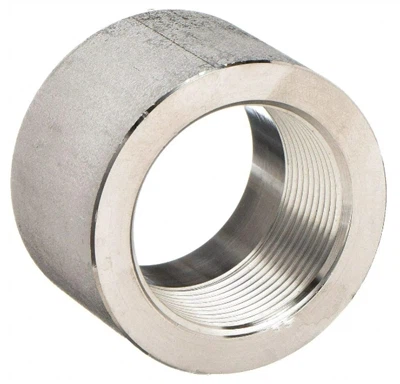
Threaded fittings, also known as screwed fittings, have threads on both ends, allowing them to be screwed onto pipes without the need for welding. These fittings are versatile and can be easily installed or removed. Threaded fittings find applications in industries such as plumbing, fire protection, and water treatment.
Elbow Fittings
Elbow fittings are used to change the direction of a piping system. They come in various angles, with 45-degree and 90-degree elbows being the most common. Elbow fittings are crucial for routing pipelines around obstacles or changing the flow direction in a controlled manner.
Tee Fittings
Tee fittings are named for our T-shaped design. They are used to create branch connections in a piping system, allowing the flow of fluid or gas to be divided into two directions. Tee fittings are essential in systems where multiple lines need to be connected.
Cross Fittings
Cross fittings, also known as four-way fittings, have four openings in a cross-shaped configuration. They are used to create branching connections in pipelines where multiple lines intersect. Cross fittings ensure equal distribution of fluid or gas in different directions.
Application of Forged Pipe Fittings
There are many different applications in which forged steel pipe fittings would be ideal. These include oil, gasoline, hydraulic machinery, fertilizing, chemical or other industries. Because of the leak free connections created from fittings made from forged steel, forged pipe fittings are ideal in the transfer of these potentially harmful materials. When it comes to oils or chemicals having any type of leak within your connection can be very dangerous. Forged steel fittings will ensure that neither fumes, nor the chemical or oil itself leaks from your piping connection.
Along with leak free connections, it is as if forged steel fittings were developed specifically for applications where harsh chemicals that are in need of transferring. This is because forged carbon steel fittings have a special coating which protects the alkali or acidic materials from corroding the fitting. Corrosion during the transfer of chemicals can be dangerous, not only due to the fact that the corroded pipe will eventually leak, or worse break, but also because when corrosion occurs, the chemicals within the piping material (often zinc), are released. Depending on the chemical being transferred through the piping connection, this can be very harmful and may even cause unwanted chemical reactions such as explosions. Forged steel fittings are the best options when transferring oil, gas or chemicals.
Produces high quality forged steel pipe fittings and unions in different standards, available in all classes and material grades for different applications. Our factory has complete lines of forging and advanced equipments. Our continued investments in technology help maintain a consistency in product unparalleled in the industry. State-of-the-art machining centers have reduced product variability while increasing product serviceability.
Manufacturing Processes for Forged Fittings
Pipe Fittings are made using a variety of manufacturing procedures to create Elbows, Tees, Reducers, and other pipe fittings. Smooth Pipe and Welded Steel are utilised to make fittings with filler content (ERW & EFW pipes cannot be used for constructed fittings).
Internal pressure and axial feeding are used in the hydroforming tube to transform a tube into the desired shape. The operation's consequences can be predicted using the finite-element method. The qualities of the tube materials are one of the most essential parameters in tube hydroforming finite element study. The hydraulic bulging test and the tensile test are two methods for assessing the characteristics of tubular substances. The parameters of the tube content must be determined using a hydraulic bulge check to examine the finite element method for tube hydroforming in a condition that is near to real tube hydroforming.
Heated extrusion is a forging technique that involves forcing a hot billet through the hole of a moulded die. This article discusses both non-lubricated and lubricated hot extrusion. Forward or overt extrusion and reverse or indirect extrusion are the two non-lubricated types of hot extrusion. Lubrication is required in this situation. This lubrication should be achieved with glass powder in lower temperature extrusions and graphite or gasoline in higher temperature extrusions. While hot extruded materials are popular, there are a few disadvantages to hot extrusion, including the cost and maintenance of extrusion machinery.
Some of the most common cap-making techniques involve cutting a circle out of a plate and shaping it with a deep draw. Deep drawing is a technique for transforming sheet metal blanks into circular or irregular shapes that are longer than half their diameters. Deep drawing entails wrapping blank metal around a tube and then feeding it through a moulding cutting die. Sheet metal can be moulded into various shapes using a drawing press, and the finished design is determined by where the blanks are put. The metal used in deep drawing must be both malleable and resistant to stress and strain.
Flaring is used to create Stub Ends or Lap Joint Flanges. A flare or flange face is carved off at the flow end. Welding is frequently used to create stub ends after the forge block has been machined to the final dimension.
Explore the Different Processes
The connections made of the forged pipe fittings are durable and leak-proof. They are produced in compliance with the ASME. Moreover, the forged pipe fittings are constructed of stainless steel alloy, nickel, or carbon steel. The use of SS press fittings & tube press fittings makes the connection much robust and sturdiest.
Hot Forming or Extrusion Technique
In the Extrusion technique, the forged pipes are manufactured by pressing a hot billet via an opening of a molded die. The style can be both lubricated and non-lubricated. The non-lubricated extrusion technique is further categorized into two forms, that is forward or overt extrusion and reverses or indirect extrusion.
Hydraulic Bulge Technique
The hydraulic bulge process for manufacturing the forged pipes is also known as the cold forming technique. In this technique, a hydroforming duct utilizes internal pressure and axial feeding to change a tube into a perfect one. The outcomes of this procedure can be predicted via the finite-element approach. On the other hand, the properties of the tubular substance can also be determined by a tensile test or the hydraulic bulge test.
Deep Drawing Technique for Caps
In this technique, the forged caps are produced. It is one of the most rampant techniques, in which the plate is cut in a loop and molded by a deep draw. This Deep drawing is basically a procedure of turning sheet metal storage (the metal used must be malleable and resistant to any strain or stress) into a round or irregular form which can be more than half of their diameters long. The blank sheet metal, which is warped around a tube, is then kept in a die known as the molding cutter. This technique can also be used to mold the sheet metal into myriad other forms.
Flare Technique for Stub Ends
The flare technique is another method used for the manufacturing of the stub ends. This flaring method makes the stub Ends or Lap Joint Flange by cutting out the flange face. These stub ends are also made by welding, where the forge raw material is machined to the resultant dimension.
3 Effective Forged Steel Fittings You Need To Know
One helpful component of installing a piping system is forged steel fittings. There are different types of them that help to blank off pipe ends.
1. CAP
A pipe cap is used as a protective device to protect pipe ends of different shapes. They're inserted over the end of a pipe, and it terminates flow. They can close the ends of pneumatic or hydraulic tubes and pipes. They're one of the most highly demanded fittings used to blank off pipe ends. The way pipe caps can be added is through directly welding them to die at the end of the pipeline.
2. PLUG
Pipe plugs are similar to caps in that they're inserted at the end of a pipe. They come in various head types such as a hex shape, round shape, or square shape. They can be used for blocking the ends of pipes to prevent contaminants or dirt from entering pipelines while it's being repaired.
3. BLIND FLANGE
Another type of forged steel item is a flange. Blind flanges are used to block off an unused section of a pipe or nozzle. Nozzles are usually blanked off for pressure tests at a plant, or sometimes because a company doesn't need all the nozzles that are supplied on the tank.
Blind flanges can be placed at the end of a valve to help ensure that the accidental opening of a valve won't cause the process fluid to escape. Additionally, they allow for easier access to the pipe in the event that work needs to be done inside the line. Blind flanges are commonly used for high-pressure applications.
Our Factory
Sino Special Metal (SSM) is a highly respected and reputable manufacturer, distributor, and stockist of a wide range of industrial products, including Pipes, Pipe Fittings, Flanges, Bolts, Round Bar, Steel Plate, Welding Wire, Steel Prefabrication, and more. With over 30 years of experience in special metal product development, manufacturing, and marketing, SSM has established itself as a leading provider of integrated piping solutions to a diverse range of industries worldwide.
FAQ
Hot Tags: forged pipe fittings, China forged pipe fittings manufacturers, suppliers, factory, mild steel elbow, stainless steel couplings, titanium threaded pipe fittings, Duplex Steel Pipe Fittings, mild steel flange, stainless steel tee
Next
Flush BushingYou Might Also Like


Send Inquiry